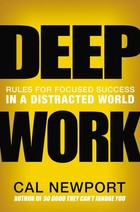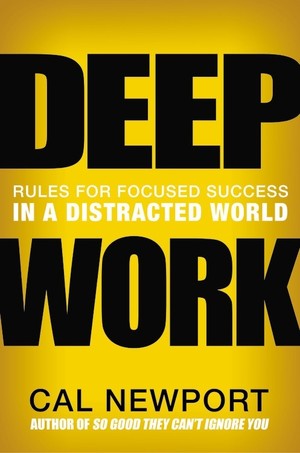
Let’s be honest: does your average workday feel like a frantic game of digital whack-a-mole? An email pings, so you switch tabs. A Slack notification pops up, pulling you away from the email. Then your phone buzzes. By the end of the day, you feel exhausted and busy, but what did you actually accomplish? If that scenario hits a little too close to home, then Cal Newport’s Deep Work: Rules for Focused Success in a Distracted World isn't just a book you should read; it's a manual for survival in the 21st century.
I picked up Deep Work feeling like my attention span was shattered into a million tiny pieces. I was a master of multitasking, or so I thought. In reality, I was a master of starting ten things and finishing none of them with the quality they deserved. This book was the wake-up call I desperately needed.
What Exactly Is "Deep Work"?
Newport’s central idea is brilliantly simple. He divides all professional activities into two categories:
- Deep Work: Cognitively demanding tasks that require intense, uninterrupted focus. This is the work that creates new value, improves your skills, and is hard to replicate. Think writing a complex report, learning a new coding language, or developing a business strategy.
- Shallow Work: Logistical-style tasks that are non-demanding and often performed while distracted. This work doesn't create much new value and is easy to replicate. Think answering most emails, attending status update meetings, and scrolling through social media.
The problem? Our modern work culture glorifies shallow work. Being "responsive" and constantly available is seen as a sign of productivity. Newport argues this is a dangerous illusion. The real breakthroughs, the work that gets you promoted and provides genuine satisfaction, happen only during periods of deep, sustained focus.
Part One: The Diagnosis. Part Two: The Cure.
Newport structures the book perfectly for both the skeptic and the believer.
Part One is the "why." He makes a compelling, evidence-backed case that the ability to perform deep work is becoming both increasingly rare and increasingly valuable in our economy. He doesn't just say "distraction is bad"; he celebrates the immense power of its opposite. He weaves in fascinating stories, from Carl Jung building a stone tower in the woods to find focus, to a modern writer buying a round-trip ticket to Tokyo simply to write distraction-free on the plane. This section convinces you that the problem is real and the prize for solving it is huge.
Part Two is the "how." This is where the book transforms from a compelling argument into an actionable training program. Newport presents four concrete "rules" to rewire your habits and reclaim your focus.
The 4 Rules to Reclaim Your Focus
This isn't a list of flimsy "life hacks." These are robust strategies for fundamentally changing how you work.
- Rule #1: Work Deeply. You can't just hope for deep work to happen. You have to schedule it with ruthless intention. Newport outlines different philosophies, from the "monastic" approach (isolating yourself for long periods) to the "journalistic" approach (fitting deep work into any free moment you can find). The key is to find a rhythm that works for you and protect that time fiercely.
- Rule #2: Embrace Boredom. This was a game-changer for me. Newport argues that if you can't resist pulling out your phone every time you're in a grocery line, you'll never be able to resist digital distractions when it's time to do hard work. You must train your "concentration muscles" by allowing yourself to be bored.
- Rule #3: Quit Social Media. Before you panic, this rule is more nuanced than the title suggests. Newport’s point is to be a craftsman, not a luddite. You should audit every major network you use and ask a simple question: "Does this tool provide a significant, direct benefit to my professional or personal goals?" If the answer is a vague "I guess," you should consider quitting.
- Rule #4: Drain the Shallows. This rule is about minimizing the time you spend on shallow work to maximize time for deep work. This involves things like scheduling your entire day, becoming harder to reach, and being more deliberate with your email habits.
So, Is "Deep Work" Right for You?
This book is an indispensable guide for almost anyone in a knowledge-based profession, but it will be particularly life-changing if you are:
- A student struggling to study effectively for exams without getting distracted.
- A professional who feels perpetually overwhelmed by emails and meetings, with no time for "real work."
- A creative (writer, artist, designer, programmer) whose livelihood depends on producing high-quality, original work.
- Anyone who feels their attention span has been hijacked by technology and wants to learn how to focus again.
However, you might want to skip it if you are looking for a quick five-minute fix. Deep Work is not a productivity checklist; it’s a philosophy that requires commitment. It demands that you take a hard look at your habits and make significant, sometimes uncomfortable, changes.
The Final Verdict
Deep Work gave me the vocabulary and the framework to fight back against the constant pull of distraction. It’s not about working more; it’s about getting more value out of the hours you already work. If you feel like you're running on a hamster wheel of busywork and crave the satisfaction of producing something meaningful, consider this book your official training manual. It’s a powerful antidote to the frantic, shallow world we live in.