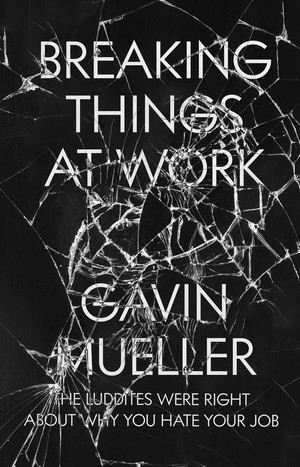
Breaking Things at Work: The Luddites Are Right About Why You Hate Your Job
Gavin Mueller reclaims the history of the Luddites to explain why modern work often feels draining and invasive. While history books dismiss nineteenth-century machine breakers as enemies of progress, Mueller argues their resistance was a logical response to losing autonomy. He connects these early industrial protests to today's digital landscape, where algorithms and constant surveillance tighte…
Shelves
More like this

Interaction of Color
Josef Albers presents color not as a fixed science, but as a dynamic and deceptive medium that changes based on its surroundings. This classic wor…
How We Became Posthuman: Virtual Bodies in Cybernetics, Literature, and Informatics
N. Katherine Hayles tracks the historical transformation of humanity into the posthuman, exploring how we began to view information as something s…

Nexus: A Brief History of Information Networks from the Stone Age to AI
From the author of Sapiens comes the groundbreaking story of how information networks have made, and unmade, our world. For the last 100,00…

Scorched Earth: Beyond the Digital Age to a Post-Capitalist World
Jonathan Crary delivers a sharp critique of the digital age, arguing that our obsession with connectivity is inseparable from the final, destructi…
Understanding Media: The Extensions of Man
Terms and phrases such as "the global village" and "the medium is the message" are now part of the lexicon, and McLuhan's theories continue to cha…

Computers As Theatre
Brenda Laurel offers a unique perspective on technology by treating human-computer interaction as a form of performance. Drawing on Aristotle’s Po…

The Pentagon of Power
Lewis Mumford offers a profound examination of how modern civilization became subservient to the pursuit of absolute power and technological domin…
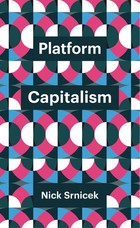
Platform Capitalism
Nick Srnicek explores the shift from traditional industry to a digital landscape dominated by data-driven firms. He argues that data has become th…

Weapons of Math Destruction: How Big Data Increases Inequality and Threatens Democracy
We live in the age of the algorithm. Increasingly, the decisions that affect our lives--where we go to school, whether we can get a job or a loan,…
On the Mode of Existence of Technical Objects
Gilbert Simondon challenges the traditional divide between humanity and technology by treating machines as evolving entities with their own unique…
The Gutenberg Galaxy: The Making of Typographic Man
Marshall McLuhan explores how the invention of the printing press fundamentally altered the human mind and social structures. This foundational wo…

Future Histories: What Ada Lovelace, Tom Paine, and the Paris Commune Can Teach Us About Digital Technology
Lizzie OShea challenges the obsession with innovation by looking backward to solve the dilemmas of our high tech era. She argues that the keys to …